
Middlesex Arrest Warrant Starting Point
Start with the court or agency named on any notice you have, never with a third-party name search. A docket number points to GA 9 or the Middlesex JD. An incident number points to the investigating department. Match those details first. The clerk can then answer a focused question about Middlesex County warrant status, and mistaken identity stays less likely. If you have no identifier at all, a lawyer can run the official checks without treating one quiet public portal as clearance.
Arrest Warrants in Middlesex County
An arrest warrant is a judge's order to take someone into custody. The road there starts with an investigation, moves to prosecutor review, and ends with a request to a judge. The judge asks one question: does sworn material establish probable cause? That means a reasonable basis to think a crime happened and this person committed it. In Middlesex County the issuing trial court is Connecticut Superior Court. Two locations split the work. Middlesex Judicial District handles the serious felony and district-level cases, while Middletown GA 9 takes misdemeanors, motor-vehicle matters, and lesser felonies for fifteen towns. There is no Middlesex County sheriff warrant division. Local police departments and State Police investigate and serve the criminal warrants here.
Middlesex Probable Cause Path
The Division of Criminal Justice lays out the usual path for a Middlesex County arrest warrant. Police investigate. A prosecutor reviews the evidence. The prosecuting authority seeks the warrant, and a judge weighs probable cause independently. Connecticut's constitutional oath requirement and Chapter 959 govern that process. The judge can sign the application, decline it, or set release conditions. A search warrant works differently. Under §54-33a it permits a search or seizure based on sworn probable-cause facts, but it does not command an arrest by itself. A summons differs too, since it simply tells the recipient to appear. Rely on the actual docket and process label in Middlesex County records, not on a charge or investigation alone.
What a Middlesex Arrest Warrant Contains
The official blank arrest-warrant form shows what a Middlesex County application contains without exposing any private person. A completed version may hold sensitive narrative and stay sealed until execution. After arrest, Connecticut FOI law generally opens the arrest record, though sealing, erasure, juvenile, investigative, informant, safety, and identifier rules still apply.
| Application | Prosecuting authority’s request to a Superior Court judge |
|---|---|
| Accused and offense | Identifiers and alleged statutory charge |
| Sworn support | Complaint or affidavit facts offered for probable cause |
| Judicial finding | Judge’s decision, signature, and arrest command |
| Release terms | Promise, nonsurety bond, surety bond, or conditions |
The application is an accusation.
Middlesex Warrant Systems Are Split
Warrant data in Middlesex County lives in separate systems. PRAWN, the Paperless Arrest Warrant Network, lets authorized agencies query warrants and responsible agencies, but the public cannot search it. The public Judicial Branch warrant search covers only limited VOP, FTA, and incarceration-order information, not all arrest warrants, and its safety and youthful-offender exclusions matter. Public case lookup is the practical fallback. Search pending cases by defendant, docket, daily docket, or court location. Then call GA 9 at 860-343-6445 or Middlesex JD at 860-343-6400. Reach out to the police or State Police agency involved for its identification and surrender procedure; it may decline to share restricted data by phone. A lawyer can confirm Middlesex County warrant status and plan an appearance.
How Middlesex Arrest Warrants Are Served
Municipal police in Middlesex County and Connecticut State Police do the actual serving. The Middlesex State's Attorney lists the municipal departments and the State Police troop and resident-trooper arrangements across the region. Smaller towns may route work through Troop F or a resident-trooper office instead of a municipal department. The agency named in a case or incident record is your best starting clue. After service, police bring the accused before the judicial authority under the applicable process. Release might mean a written promise, a bond without surety, a surety bond, or added conditions. The precise order controls. No website result can set bond, schedule a surrender, or promise release in Middlesex County. Ask for counsel, the next court date, and a copy of the written release terms.
Middlesex Warrant Workload Context
The official 2024 Middlesex Judicial District report recorded 965 arrest-warrant applications reviewed, plus 106 search-warrant applications. Those are application totals, not a current wanted list for Middlesex County. Submitting agencies included Middletown, Cromwell, Clinton, Old Saybrook, East Haddam, East Hampton, and Portland police, State Police, Adult Probation, and DMHAS Police.
These figures explain why no single town page can settle every Middlesex County arrest warrant question. Court files, agency records, and restricted statewide data each serve a different role. No number here names a person or proves how many warrants stay active today.
Middlesex Warrants and Other Process
Each process differs. An arrest warrant rests on alleged probable cause. A summons directs an appearance without any arrest command. A bench or rearrest warrant usually follows a missed date or violation in an existing Middlesex County case. All three can lead to a docket, yet one search screen may not show them all.
| Process | Trigger | Immediate command |
|---|---|---|
| Arrest warrant | Judicial probable-cause finding | Officer arrests accused |
| Summons | Charge or court process | Recipient appears in court |
| Bench or rearrest | Missed duty in existing case | Return person to court |
For missed-court process, see the Middlesex County bench warrant route.
Middlesex Arrest Record Access
Connecticut treats arrest records as public through General Statutes §1-215, which also opens warrant applications and affidavits once an arrest has happened. The Freedom of Information Commission explanation spells out the rules. Before a warrant is executed, though, your access may be narrower. Some material stays closed no matter what. Juvenile records are confidential under §46b-124, and sealed, erased, active-investigation, safety-sensitive, and personal data can be withheld or redacted. So in Middlesex County, go to the agency that holds the item you want. A docket, police incident report, booking record, warrant application, affidavit, and service return may sit with different offices. Describe the record, the date range, the agency, and the docket number if you have it. When a narrative is exempt, ask that non-exempt parts still be released, such as the docket, agency, process type, date, and status.
Confirm Your Middlesex Warrant Status
Work official channels in order. Start with the limited warrant interface and the court case lookup. Then call the right clerk with your legal name, birth year, and docket. Ask the police agency in Middlesex County how it verifies warrants or handles surrender. Talk to private counsel or the public defender before you set any appearance. Public Defender service hinges on court eligibility and appointment.
- Record the court, docket, and exact process type.
- Ask whether it is active, recalled, executed, or sealed.
- Discuss appearance and release risks with counsel.
- Follow the court or responsible agency’s instructions.
- Keep the written disposition and new docket entry.
For a VOP matter, Adult Probation at 860-344-2998 can help. If someone poses an immediate threat, call 911 instead of approaching them.
If a Middlesex Warrant Is Yours
Never test an unconfirmed result with an unplanned stop at a police station. A Middlesex County lawyer can pull the court file, reach the right agency, arrange voluntary surrender, and explain release conditions. The clerk will tell you where the case sits and give official appearance directions. No commercial caller or bond agent can erase a Superior Court warrant.
Act carefully: Confirm the court and process, seek counsel, and use only official surrender, appearance, payment, and release instructions.
Hang up on callers demanding cash, gift cards, wire transfers, or cryptocurrency to stop an arrest. That is a scam. Connecticut's State Marshal Commission has a payment-scam warning on point. If a Middlesex County warrant was served, request counsel, get the next court date, and keep the written order stating your release terms.
Middlesex PRAWN Access Boundary
PRAWN overview pages describe a closed system that only police and justice agencies can reach in Middlesex County. It handles warrant records for those agencies, but no public name-search account exists.
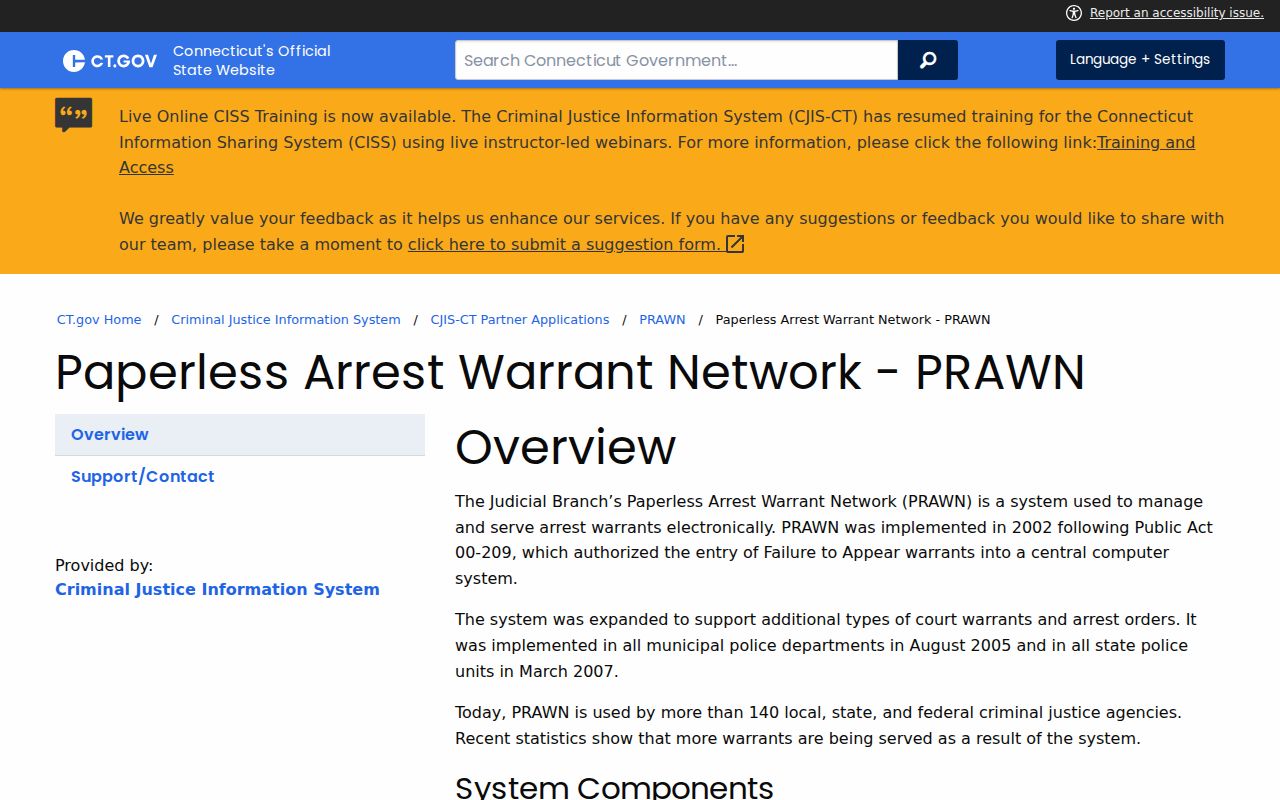
That page draws a clear line. Agency access is not a public arrest-warrant search, so Middlesex County residents still pair court tools with the clerk, police, and counsel.