
How to Check for a Warrant in Middlesex County
Begin with the limited Judicial Branch warrant portal. It searches some VOP, FTA, and orders-to-incarcerate records by name, birth year, town, and court. Coverage is partial. Its current notice says FTA warrants stay hidden until further notice, so work through every Middlesex County channel in turn.
- Search the limited portal with at least two letters of the last name, then add first name and birth year.
- Try the town, Middletown GA 9, and Middlesex JD court filters.
- Check pending criminal and motor-vehicle cases by defendant or docket number.
- Call GA 9 at 860-343-6445 or Middlesex JD at 860-343-6400.
- Contact the police agency, Adult Probation, counsel, or public defender when the process calls for it.
No public search resolves an active warrant in Middlesex County. Only the court or authorized legal action can change one.
Middlesex County Warrant Portal Fields
The public warrant form needs no login, payment, or subscription, and nothing exports. Start with a last name of at least two letters. You can narrow it with a first name, a four-digit birth year, a one-digit year range, town, and court location. Try both local choices: Middletown GA 9 and Middlesex JD.
| Field | Entry | Local Use |
|---|---|---|
| Last Name | 2 to 30 letters | Required base query |
| First Name | Begins with | Reduces false matches |
| Birth Year | 4 digits, optional range | Tests identity |
| Town | Statewide list | Select a Middlesex town |
| Court | Statewide list | Try GA 9 and Middlesex JD |
A blank Middlesex County result can mean a missing type, sealing, fresh issuance, a stale query, or the FTA suppression. It is not clearance.
Types of Warrants in Middlesex County
Connecticut uses several forms of process. A Superior Court judge or judge trial referee issues criminal warrants after the required showing. Police never issue one themselves. They apply for process in Middlesex County and then serve it.
| Type | How It Arises | Issuing Authority |
|---|---|---|
| Arrest warrant | Probable-cause application for an alleged offense | Superior Court judge |
| Rearrest warrant or capias | Failure to appear or violation of a court condition | Superior Court |
| VOP warrant | Alleged violation of probation | Superior Court |
| Search warrant | Sworn probable cause to search or seize | Judge |
| Civil capias | Failure to obey civil, family, or witness process | Issuing court |
In Middlesex County, a search warrant permits a search rather than an arrest, while a civil capias moves through its own state-marshal route.
Middlesex County Uses Courts, Not a Sheriff
Connecticut has no Middlesex County sheriff warrant division today. The criminal trial court is Connecticut Superior Court. Local police and State Police handle investigations and service, while state marshals work civil process, including some civil capiases. The official state-marshal county structure shows that separate civil channel.
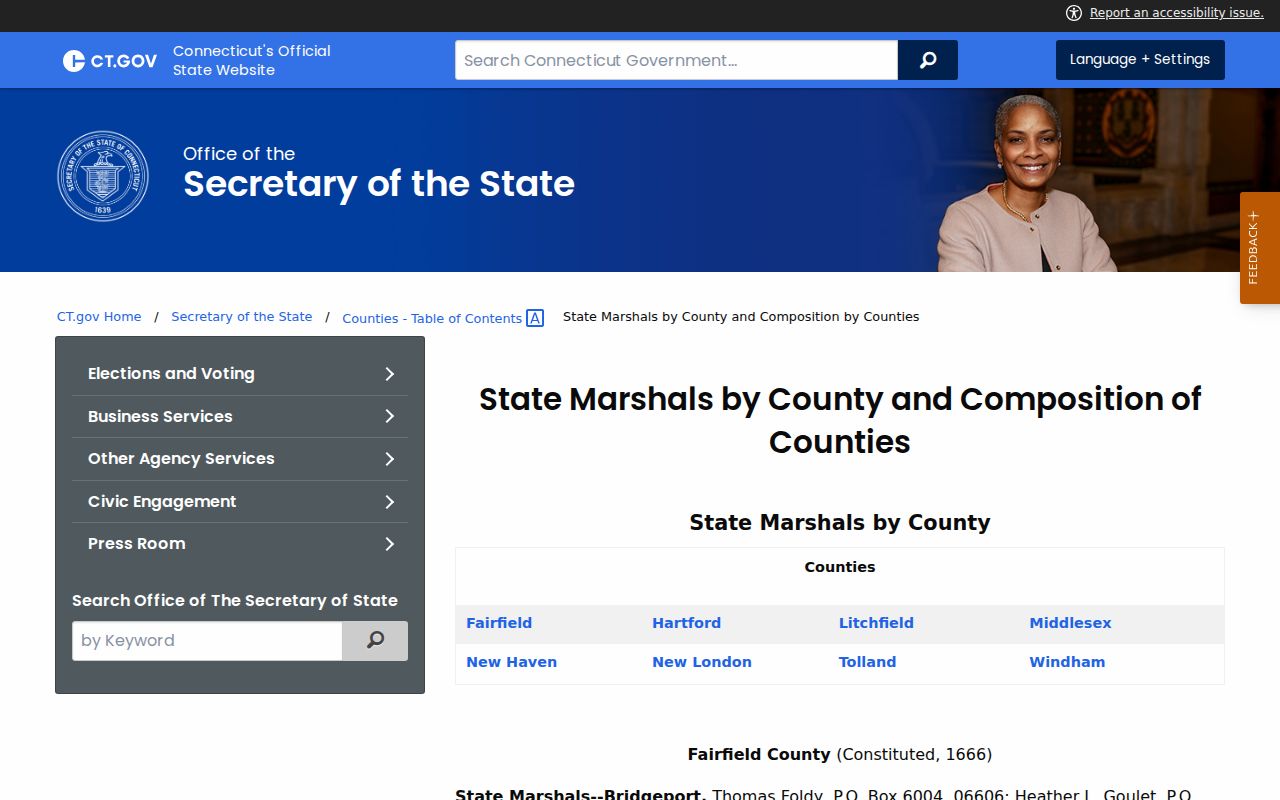
That page draws the line clearly. A state marshal is no stand-in for a Middlesex County sheriff, so don't call one for routine criminal warrant status.
What a Middlesex County Warrant Record Shows
Portals, dockets, applications, affidavits, and service returns each carry different fields. A completed Middlesex County application can hold sealed investigative detail, so the public case lookup shows less. Confirm anything with the clerk.
| Issuing Authority | The Superior Court judge or judge trial referee. |
|---|---|
| Docket | A court identifier such as MMX-CR-24-0000000-S. |
| Basis | An alleged offense, missed appearance, order violation, or probation issue. |
| Issue Date | The date and time process was signed or entered. |
| Release Condition | Promise to appear, bond without surety, bond with surety, or another order. |
| Status | Active, recalled, vacated, executed, resolved, stayed, or sealed. |
| Return | Service or execution information held by the court or serving agency. |
Trust the court's exact status over a stale online label; the newer clerk entry for a Middlesex County warrant controls.
Pending Middlesex County Criminal Records
When the warrant portal shows no FTA, try the pending defendant search. It takes last name, first initial, and birth year. You can narrow it by court and by criminal, motor vehicle, or license and registration suspension referral categories.
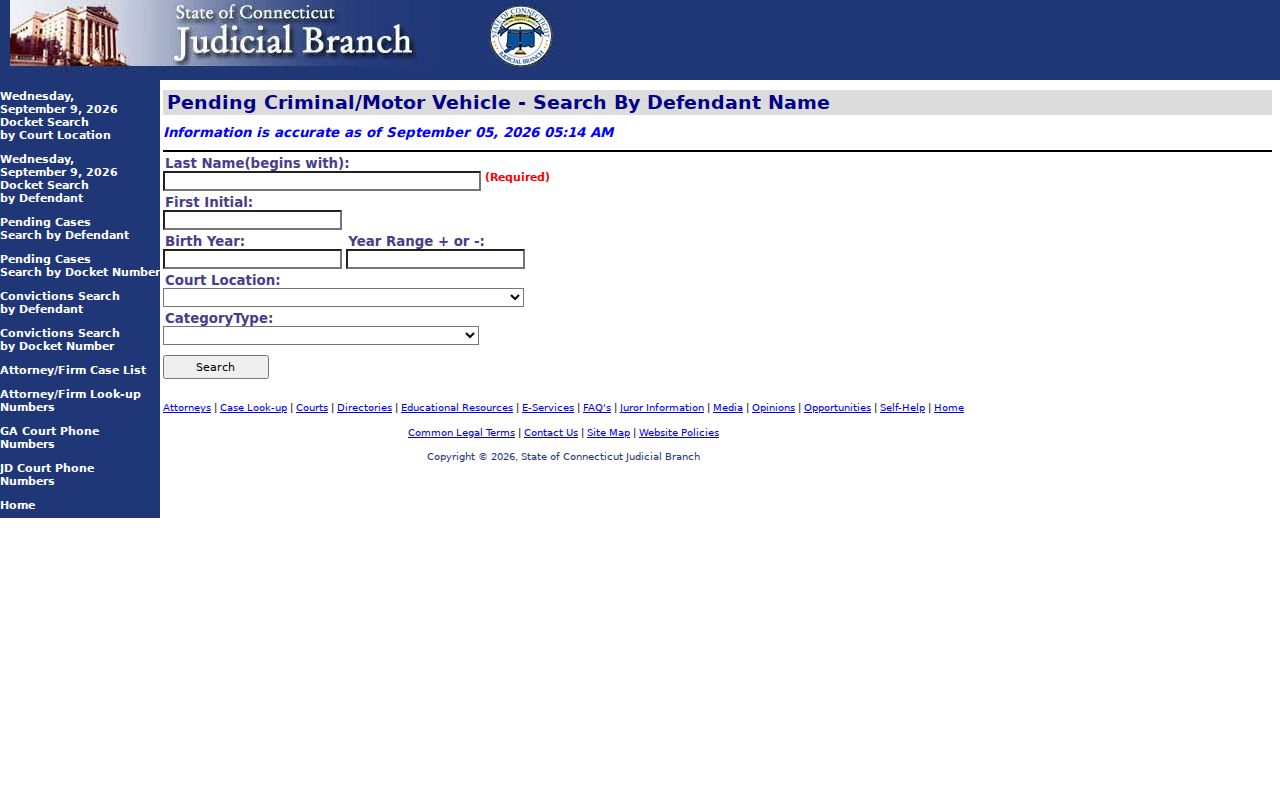
The portal may list a docket and the next event date, but the Judicial Branch warns that its web results are not the official court record. Before acting on any Middlesex County status, call the clerk.
Who Issues and Serves Middlesex County Warrants
Middlesex JD takes the serious and district-level criminal cases. GA 9 handles misdemeanors, lower-level felonies, motor-vehicle matters, and the criminal dockets for Chester, Clinton, Cromwell, Deep River, Durham, East Haddam, East Hampton, Essex, Haddam, Killingworth, Middlefield, Middletown, Old Saybrook, Portland, and Westbrook.
The process line is: police investigation and prosecutor review → judge's probable-cause decision → police or State Police service → court appearance and return. State marshals serve the separate civil track.
PRAWN and Middlesex County Warrant Access
PRAWN, the Paperless Arrest Warrant Network, is restricted infrastructure for authorized agencies inquiring into warrants and handling custodial processing. Records move among court and justice systems, including CRMVS, COLLECT, and CISS. The public gets no PRAWN login, and the official overview marks that boundary for Middlesex County warrant access.
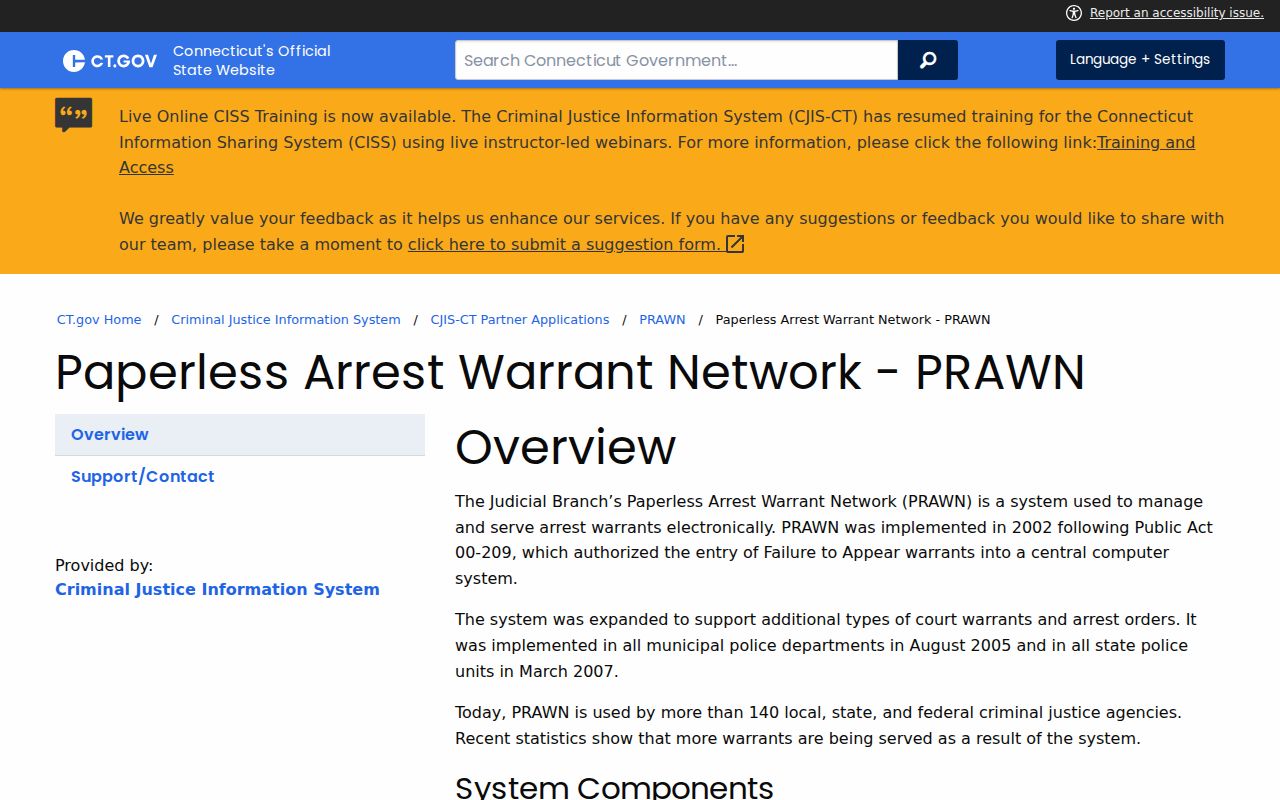
Skip waiting for a full public list. In Middlesex County, warrant access runs through the narrow warrant portal, case records, the clerk, a precise FOI request, and the agency that holds the record. PRAWN itself explains the catch: a no-result lookup cannot prove no warrant exists.
What to Do If You Have a Middlesex County Warrant
Start by finding the issuing court and the process type from a notice, docket, portal entry, or the clerk. Then call the official clerk number. Ask how the appearance or surrender procedure works for your Middlesex County warrant. A lawyer can check the warrant's status, talk through a court filing, and plan for release conditions. The GA 9 Public Defender sits at 860-343-6480; the court alone controls eligibility and appointment. Facing a failure to appear? Ask whether a rearrest warrant or capias issued, and whether a new appearance or motion is required. For a VOP, bring in Adult Probation at 860-344-2998. If arrested, request counsel and ask about the statutory release process. Before you leave any conversation, get written confirmation of your status and the next court date.
Important: Get legal advice before surrender or travel; a records request, phone assurance, or online payment does not itself clear court process.
Middlesex County Warrant Terms in Plain English
Connecticut's labels don't always match everyday shorthand. In Middlesex County, read the exact docket word before choosing an office or resolution path.
- Bench warrant
- Public shorthand for court process after a missed duty or violated condition.
- Rearrest warrant
- Connecticut term often tied to failure to appear or a release violation.
- Capias
- Process directing arrest or appearance; criminal and civil uses differ.
- FTA
- Failure to appear, currently suppressed from ordinary public warrant results.
- VOP
- Violation of probation, requiring coordination with court, counsel, and probation.
- Recall, Vacate, or Quash
- Court actions that can change process; use the clerk's exact status.
A state marshal may execute a civil capias. Don't blend that Middlesex County paper with a criminal arrest warrant.
Public Access to Middlesex County Warrant Records
Connecticut's Freedom of Information Act, General Statutes §§1-200 through 1-259, covers public-agency records. It does not create a full online warrant list. In Middlesex County, court records and police records also sit with different custodians.
Key rules:
CGS §1-215 addresses the public record of an arrest and warrant application and affidavit access after a warrant arrest, subject to exceptions.
CGS §46b-124 protects juvenile court, police, arrest-warrant, and search-warrant materials.
CGS §§54-2a and 54-33a set judicial requirements for criminal and search warrants.
Ask the Middlesex County custodian for any segregable non-exempt material and the legal basis for withholding. Sealed, erased, juvenile, investigative, victim, informant, medical, and identifying details may stay protected.
Middlesex County FOI Requests by Custodian
A good Middlesex County FOI request tells the agency exactly what it wants. Name the department, the record type, the dates, and any docket or incident number. Clerk files cover docket entries, release conditions, and formal status. Police files cover investigation, arrest, service, and return paperwork. OPM keeps only aggregate reports.
Middlesex County Workload Without a Roster
The 2024 Middlesex JD report offers aggregate context on warrant applications and GA 9 case flow, naming the submitting agencies and the fifteen-town service area. Treat those figures as workload measures, not a count of active outstanding warrants. OPM monthly reports, usually posted near the first of the month, tabulate town counts for FTA criminal, motor vehicle, and VOP categories. A tally cannot tell you whether any particular Middlesex County warrant is still open. With no roster, the distinctions among issued, denied, executed, recalled, sealed, and pending process stay intact.
Middlesex County Electronic Warrant Changes
Connecticut law changed on October 1, 2024. Warrants, affidavits, and judicial findings can now be signed and verified electronically. That modernizes the paperwork only. Restricted applications stay sealed, probable cause is still required, and Middlesex County still has no public countywide warrant search. The state backbone remains PRAWN for authorized users, with limited Judicial Branch interfaces for the public. Display rules can shift. The warrant portal suppresses failure-to-appear results, so read the current notices before each search.
Warrant Records by City in Middlesex County
Middlesex County's five largest towns share GA 9 and the Middlesex judicial district. Each police department keeps its own agency-side records and contacts. None has a separate municipal criminal court. None posts a public local warrant list. Each city page explains how those police files connect to Superior Court status.
East Hampton
Support Services processes citations, warrants, and court packages
Call 911 for urgent safety concerns in Middlesex County. For warrant status, use the court clerk, the official police contact, or your counsel rather than any third-party list.
Middlesex County Court and Police Record Split
A Middlesex County warrant question usually spans two custodians. The Superior Court clerk in Middlesex County keeps the docket, the formal process, appearance dates, release conditions, and current judicial status. The investigating or serving department may hold an incident file, application materials in its custody, an arrest report, correspondence, and the return showing what an officer did. Ask only one, and you may get a correct but incomplete answer. Requests work better with specifics. For a police-held record, name the department, the incident or docket number, the approximate date, and the exact item you want. For a court-held record, give the legal name, birth year, court location, docket if known, and process type. Ask each office to explain any redaction or withholding. Ask also for the public parts that can be reasonably segregated. The Connecticut Freedom of Information process governs agency records, while court access rules and sealing orders still control judicial material. The split also matters after resolution. A police file can show that officers received or served process. The court docket records the later recall, release, appearance, or final disposition. Trust current Middlesex County court confirmation when deciding what to do next. Want agency history or copies? Request the separate police record. Just do not assume it changes the warrant.
Middlesex County Warrants Across Fifteen Towns
The shared GA 9 structure means town lines do not create separate criminal courts in Middlesex County. A police department in Clinton, Cromwell, East Hampton, Middletown, or Old Saybrook may investigate or serve process. The controlling criminal docket stays in Middletown. Chester, Deep River, Durham, East Haddam, Essex, Haddam, Killingworth, Middlefield, Portland, and Westbrook follow the same GA 9 routing for the matters listed in the Judicial Branch directory. So the place of investigation is not always the custodian of final warrant status. A notice may name only a town. Start with that town in the public warrant portal. Then repeat the search under Middletown GA 9 and Middlesex JD. A notice may carry an incident number but no docket. Ask the local agency whether the court assigned a number. This town-to-court check beats guessing.